Losing a tooth can affect more than the appearance of your smile. Depending on where the gap is located, it may change how comfortably you chew, speak or bite. It can also make social situations surprisingly complicated—especially when a previously harmless piece of steak begins to feel like a practical examination.
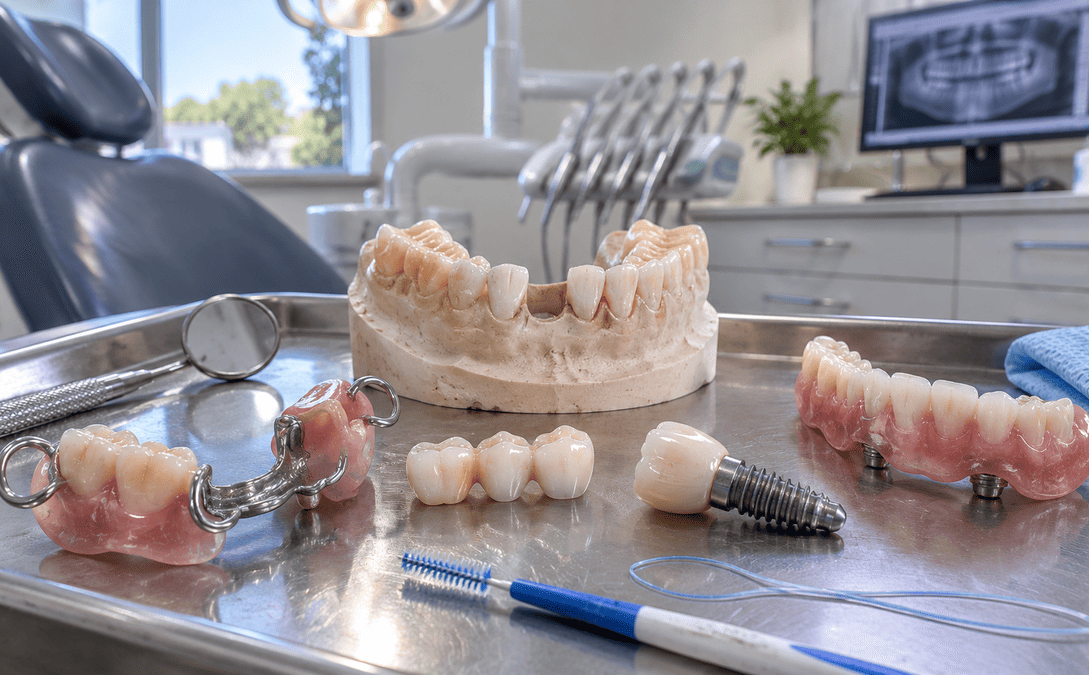
Fortunately, Dental Prosthetics for missing teeth provide several ways to restore the appearance and function of your smile. These options include removable dentures, fixed dental bridges, implant crowns and implant-supported restorations.
This guide explains the main types of Dental Prosthetics available in Australia, how they differ and what to consider before choosing treatment. It is intended to help patients prepare for a useful conversation with their dentist rather than promote one treatment as universally “best”.
At a Glance
Dental Prosthetics are custom-made replacements for missing teeth and related oral structures.
The main options include:
- Partial dentures for one or more missing teeth
- Full dentures when all teeth in an upper or lower jaw are missing
- Dental bridges fixed to teeth or implants around a gap
- Implant crowns for replacing individual teeth
- Implant-supported bridges or dentures for several missing teeth
The right option depends on the number and location of missing teeth, the condition of your gums and remaining teeth, available jawbone, medical history, budget and personal preferences.
No single solution suits every patient. A proper examination is needed before a personalised treatment recommendation can be made.
Want to understand each option before sitting in the dental chair? Keep reading.
What Are Dental Prosthetics?
Dental Prosthetics are artificial teeth or appliances designed to replace teeth that are missing or, in some cases, restore severely damaged teeth. You may also hear them described as dental prostheses.
Some are removable, while others are fixed in the mouth. They may replace:
- One missing tooth
- Several teeth in the same area
- Teeth in different areas of the mouth
- Every tooth in the upper or lower jaw
- All teeth in both jaws
Dental Prosthetics can make eating and speaking easier and may improve confidence when smiling. The shape, colour and position of the replacement teeth can often be planned to complement the patient’s remaining teeth and facial appearance.
Why Consider Replacing a Missing Tooth?
Not every gap creates the same problem. A missing back tooth may affect chewing differently from a missing front tooth, while multiple missing teeth can have a broader effect on oral function.
Replacing missing teeth may help:
- Restore a more complete smile
- Improve chewing comfort
- Make speech clearer
- Support a more balanced bite
- Reduce self-consciousness
- Prevent neighbouring teeth from leaning into certain gaps
A dental bridge, for example, fills a space and may help stop neighbouring teeth from tilting towards it, which can support bite alignment. Full dentures can also support the lips and cheeks when an entire arch of teeth is missing.
However, replacing every missing tooth is not automatically required. Your dentist will assess the location of the gap, your bite and the health of the surrounding tissues before discussing the benefits, limitations and risks of treatment.
The Main Types of Dental Prosthetics
1. Partial Dentures
A partial denture is a removable appliance that replaces one or more missing teeth when some natural teeth remain.
It generally sits partly on the gums and uses the remaining teeth for support or retention. The base may be made from acrylic or a combination of acrylic and a lightweight cobalt-chrome framework.
Partial dentures may be worth considering when:
- Several teeth are missing
- A removable option is preferred
- Implant treatment is unsuitable
- A more economical replacement is needed
- A temporary solution is required during another treatment plan
They must be removed for cleaning, and there may be an adjustment period. Like a new pair of shoes, a new denture can initially feel unfamiliar—but unlike shoes, it should not be left under the bed because it “needs time to think”.
Pro Tip: A denture that rubs, moves excessively or creates sore spots should be checked. Do not attempt to reshape it at home with tools, hot water or online enthusiasm.
2. Full Dentures
Full dentures replace all teeth in the upper jaw, lower jaw or both. They rest on the gums and are usually removable.
In addition to replacing teeth, full dentures can support the lips and cheeks. They are custom-made through several appointments involving measurements, impressions, bite records, trial fittings and adjustments.
Full dentures may take time to adapt to. Eating softer food, taking smaller bites and practising speech can help during the early adjustment period. Your dentist or dental prosthetist may also need to make minor changes to improve comfort and fit.
3. Dental Bridges
A dental bridge is a fixed replacement for one or more missing teeth. Unlike a removable denture, it remains in the mouth.
A conventional bridge commonly uses crowns placed over the natural teeth on both sides of the gap. These supporting crowns are connected to an artificial tooth that fills the space. The supporting teeth must be healthy and strong enough to carry the bridge.
Potential advantages include:
- It is fixed rather than removable
- It can restore chewing function
- It may look similar to natural teeth
- It can prevent teeth beside the gap from leaning into the space
One important consideration is that the supporting teeth usually need to be reshaped. Bridges also require specific cleaning beneath the artificial tooth, often using floss threaders, superfloss or interdental brushes.
4. Implant Crowns
A dental implant is a screw-shaped device, usually made from titanium, placed into the jawbone where the missing tooth root was located. Once the area has healed, an artificial tooth called an implant crown is attached.
Implant crowns can replace individual teeth without requiring the neighbouring teeth to be filed down for support. Treatment generally occurs in stages and requires multiple appointments. Healing commonly takes several months before the final restoration is fitted.
Implants are not suitable for everyone. Assessment may include:
- Dental and medical history
- Gum health
- Available jawbone
- X-rays or three-dimensional imaging
- Medicines and supplements
- Smoking status
- Conditions that may affect healing
Possible complications include infection, nerve injury, sinus problems and damage to nearby teeth. Patients should receive a clear explanation of the benefits, risks, alternatives and total treatment costs before proceeding.
5. Implant-Supported Bridges and Dentures
Dental implants can also support Dental Prosthetics that replace multiple teeth.
An implant-supported bridge uses two or more implants to hold a connected series of artificial teeth. An implant-retained denture attaches to implants for additional stability but can still be removed for cleaning.
These options may provide greater stability than conventional removable dentures, but they involve surgery, sufficient healing time and a detailed suitability assessment.
How Does a Dentist Recommend the Right Option?
Choosing Dental Prosthetics is not simply a contest between “fixed” and “removable”. Your dental practitioner will consider several interconnected factors.
Number and position of missing teeth
One missing tooth may be managed differently from several missing teeth or a completely toothless jaw.
Condition of the remaining teeth
A conventional bridge requires suitable supporting teeth. If those teeth are weak, heavily restored or affected by gum disease, another solution may be considered.
Gum and jawbone health
Healthy gums are important for every treatment. Implant treatment also depends on having enough suitable bone to support the implant.
Your ability to maintain the prosthesis
Each option has different cleaning requirements. A technically impressive restoration is not a successful solution when the patient cannot maintain it comfortably.
Time, cost and treatment preferences
Dentures are generally considered a cost-effective tooth-replacement option, while implant treatment can be more expensive and involves several stages. Australian private health insurance policies vary significantly, and major dental cover may include dentures, bridges or implants subject to limits, exclusions and waiting periods.
Ask for a written treatment plan and quotation before agreeing to treatment.
Quick Guide: Choosing Between Your Options
Imagine that you have lost one or more teeth and are ready to explore treatment, but every option seems to arrive with its own vocabulary, appointment schedule and cleaning gadget.
Common challenges
- Are you unsure whether you want something removable or fixed?
- Are you worried about treatment time or surgery?
- Do you know the initial cost but not the long-term maintenance needs?
How to solve it
Begin with a complete assessment
The dentist should examine your gums, remaining teeth and bite before recommending a solution.
Compare the complete treatment process
Ask how many appointments are involved, whether surgery is required and how long healing or laboratory work may take.
Request all realistic alternatives
There may be several clinically appropriate choices. Ask about the advantages, disadvantages and likely maintenance of each one.
Discuss the total cost
Confirm whether the quotation includes imaging, temporary teeth, surgery, laboratory work, adjustments and follow-up appointments.
Why it works
This approach helps you compare treatments based on suitability, maintenance and long-term expectations—not simply the first price or the most polished brochure.
Need help replacing missing teeth? Arrange a dental assessment and ask for a personalised comparison of suitable Dental Prosthetics.
How to Care for Dental Prosthetics
Dental Prosthetics still require daily care. Artificial teeth may not decay in the same way as natural teeth, but the surrounding gums, supporting teeth and implant tissues can still develop problems.
General care may include:
- Brushing natural teeth and gums twice daily
- Cleaning around bridges and implants every day
- Removing and cleaning removable dentures as instructed
- Attending regular dental examinations
- Reporting looseness, soreness, swelling or difficulty chewing
- Avoiding home repairs using household glue
Implants cannot develop tooth decay, but inflammation and bone loss can occur around them. Untreated peri-implant disease may cause an implant to loosen or fail.
Your dental practitioner should demonstrate the right brushes, flossing aids or denture-cleaning method for your specific restoration.
Mini Quiz: Which Features Matter Most to You?
Select the answer that sounds most like your priorities.
1. How do you feel about removing your replacement teeth?
- A: I prefer a fixed option.
- B: I am comfortable with something removable.
- C: I need to understand both options first.
2. How do you feel about surgery?
- A: I would consider it if I am suitable.
- B: I strongly prefer non-surgical treatment.
- C: I need more information about the process and risks.
3. What matters most?
- A: A fixed, natural-feeling replacement
- B: Simpler treatment and affordability
- C: Replacing several teeth with a stable solution
Your result
- Mostly A: Ask whether an implant crown or implant-supported restoration is clinically suitable.
- Mostly B: Discuss removable dentures or a conventional bridge.
- Mostly C: Request a full comparison covering dentures, bridges and implant-supported options.
This quiz cannot determine which treatment is safe or appropriate. It is designed to help you identify questions for your consultation.
Frequently Asked Questions
Do Dental Prosthetics look natural?
Modern restorations can be designed to resemble natural teeth in colour, shape and proportion. The final appearance depends on the material, position of the missing teeth, gum condition and treatment type.
Can I eat normally with replacement teeth?
Many patients find that replacing missing teeth improves eating. However, adaptation may be required, particularly with new dentures. Begin with manageable foods and follow your practitioner’s instructions.
Are dental implants always better than dentures?
No. Implants may feel more like natural teeth, but they require surgery, suitable jawbone and healthy gums. Dentures may be more appropriate when a removable, temporary or cost-effective option is preferred.
Who makes dentures in Australia?
Dentures may be made through a dentist or dental prosthetist. The process normally requires several appointments for planning, measurement, fitting and adjustment.
Will private health insurance cover Dental Prosthetics?
It depends on your policy. Bridges, implants and dentures may be categorised as major dental, but benefits, annual limits, exclusions and waiting periods vary. Check your policy and provide your insurer with the relevant treatment item numbers before proceeding.
Conclusion
Dental Prosthetics can restore missing teeth in several ways, from removable partial or full dentures to fixed bridges, implant crowns and implant-supported restorations. The right choice depends on your oral health, remaining teeth, jawbone, medical history, budget and willingness to undergo a longer treatment process. Rather than choosing an option based only on appearance or price, ask for a complete examination and a clear comparison of the available treatments. Well-planned Dental Prosthetics should be comfortable, maintainable and appropriate for your individual needs. With professional guidance and consistent daily care, your replacement teeth can help you eat, speak and smile with greater confidence.