Two building quotes can include the same kitchen, bathrooms and excavation work yet leave you with different amounts still to be settled. Before comparing the totals, check the allowances sitting inside them.
A prime cost item generally covers a fixture or fitting whose exact selection or price has not been settled. A provisional sum estimates the cost of work that cannot yet be priced accurately. Both can affect what you eventually pay. Consumer Affairs Victoria identifies these as areas to check carefully before signing a building contract. [1]
Understanding the difference helps you see which decisions you can resolve now, which uncertainties need more investigation and whether each quote allows for the home you actually want.
Quick Overview
- Prime cost items: allowances for products such as taps, basins and appliances that are not fully selected or priced.
- Provisional sums: allowances for work whose extent or cost remains uncertain, such as excavation.
- Neither is automatically a spending cap. Read the adjustment provisions.
- Check the complete cost: installation, delivery, builder’s margin and GST need clear treatment.
- Compare matching scopes and realistic allowances, alongside the quoted total.
Prime cost vs provisional sums at a glance
| What to compare | Prime cost item | Provisional sum |
|---|---|---|
| Main uncertainty | The particular product or its purchase price | The extent or cost of carrying out work |
| Typical example | A basin you have not chosen | Excavation that cannot yet be priced accurately |
| What may help settle it | Choosing a product and confirming its price | Further investigation and a clearer work scope |
| Useful question | “Which products can I buy within this allowance?” | “What assumptions support this estimate?” |
These are practical distinctions. Your contract’s definitions and schedules determine exactly what each allowance covers. For example, the QBCC new home construction contract uses separate schedules for prime cost items and provisional sums. [2]
What a prime cost allowance actually buys
Suppose the bathroom plans show a basin, but you have not chosen its make or model. The builder includes a prime cost allowance so the contract can account for the product before the selection is final.
The important question is whether that allowance matches your intended purchase.
“Basin allowance: $250” tells you less than a schedule showing the quantity, allowance per basin and what the amount includes. Ask the builder to identify available products within the allowance. You can then compare those products with your expectations before committing.

Also establish where the surrounding costs sit:
- Does the allowance cover supply only?
- Is delivery included?
- Where is installation priced?
- Would your preferred product require different plumbing, cabinetry or installation work?
The product allowance alone does not answer these questions. A basin that fits within the purchase allowance could still require work outside the agreed installation scope.
Where possible, select the actual products before signing and have their details incorporated into the contract. Consumer Affairs Victoria recommends recording selections such as make, model, colour and style rather than leaving them unresolved. [1]
What makes a provisional sum different?
A provisional sum concerns work that cannot yet be accurately priced. The uncertainty may involve quantities, site conditions or details still needed to define the job.
For excavation, ask what the allowance assumes about the ground, the volume of material to be removed, access and disposal. A figure becomes more useful when you can see what it was calculated to cover.
An allowance is still expected to have a reasonable basis. In Victoria, official guidance states that provisional sums must be reasonable estimates and that relevant site conditions need to be considered. They are not simply arbitrary figures inserted to complete a quote. [3]
Ask the builder:
“What information is missing, and could obtaining it now allow this work to be priced more accurately?”
Depending on the project, that discussion might involve the engineer, surveyor or another specialist. Our guide to site surveys before building explains the different roles of surveys and soil investigations.
Further investigation can help inform the price, but ask what uncertainty would remain afterwards.
How allowances change the amount you pay
The starting allowance and the final cost need to be reconciled under the contract. Builder’s margins and GST can affect the adjustment, so ask for a worked calculation before signing.
The following examples are hypothetical. All figures exclude GST, and the assumed 15% margin is for illustration only. It is not a standard or recommended rate.
Example 1: choosing a more expensive prime cost item
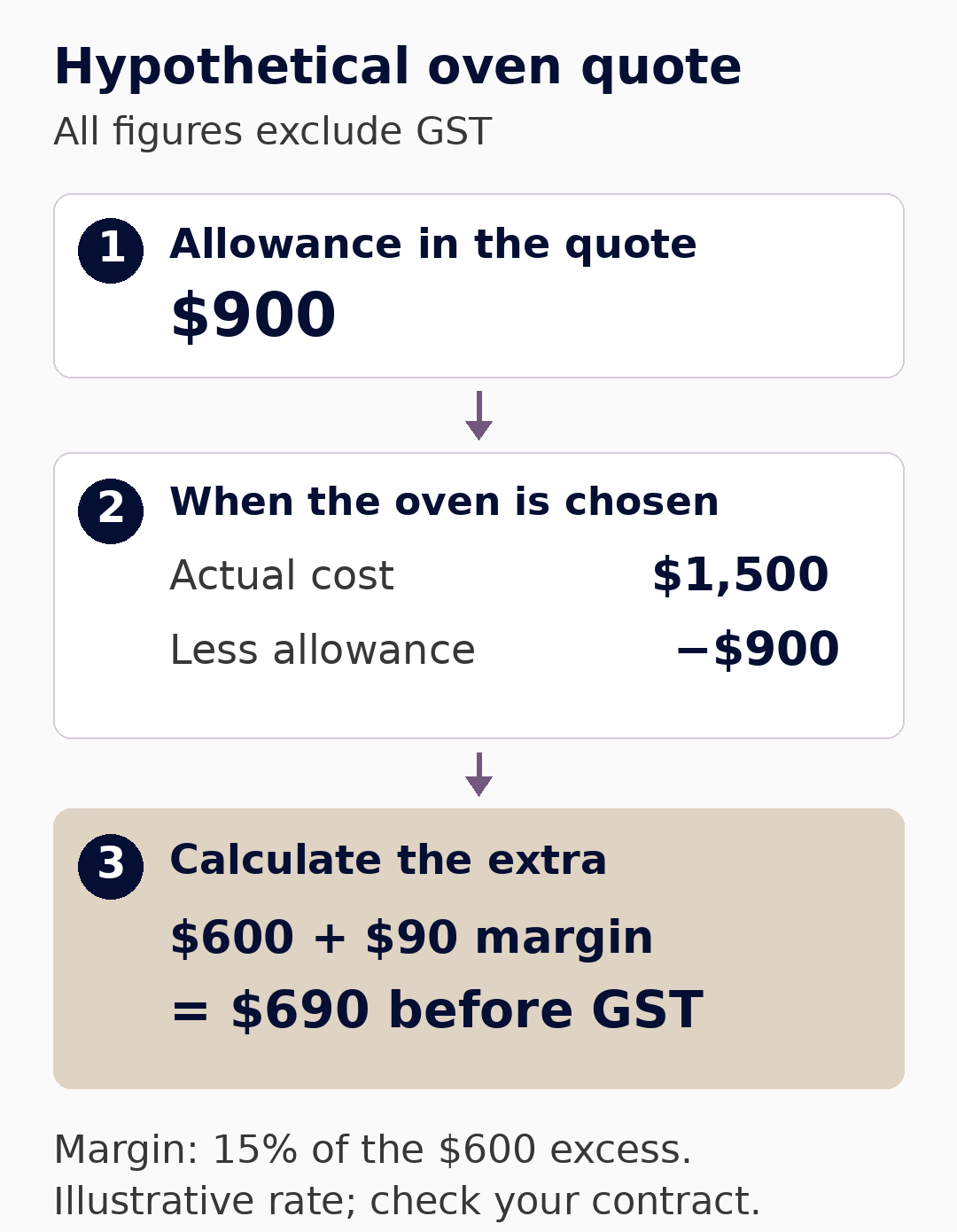
Assume your contract allows $900 for an oven. The selected oven costs the builder $1,500, and the hypothetical contract applies a 15% margin to the excess.
| Calculation | Amount |
|---|---|
| Actual oven cost | $1,500 |
| Less the allowance already included | −$900 |
| Difference | $600 |
| Assumed margin: 15% of $600 | $90 |
| Additional amount before GST | $690 |
The extra is calculated against the allowance already included. It is not another charge for the full oven price.
For this example, assume installation is already covered and does not change. If the selected oven needs additional electrical or cabinetry work, that needs a separate explanation.
Example 2: excavation exceeds a provisional sum
Now assume the contract includes an $8,000 excavation allowance. The final cost for the same covered work is $10,500, with the same hypothetical margin applying to the excess.
| Calculation | Amount |
|---|---|
| Actual excavation cost | $10,500 |
| Less the allowance already included | −$8,000 |
| Difference | $2,500 |
| Assumed margin: 15% of $2,500 | $375 |
| Additional amount before GST | $2,875 |
Your contract may use different calculations. Ask the builder to show the applicable clause and the final GST-inclusive amount.
What if the actual cost is lower?
Check how credits work as carefully as increases. For example, clauses 4.8–4.10 of the QBCC new home construction contract address increases, decreases and supporting cost documents. That particular contract provides for a deduction when the actual cost is below the estimate, including the relevant markup adjustment. Read the equivalent provisions in your own agreement. [2]
Why a “fixed-price” quote still needs checking
A fixed-price description does not, by itself, explain every circumstance in which the amount payable can change.
For example, Victorian consumer guidance identifies prime cost and provisional sum adjustments among the permitted reasons a signed building contract price may change. It also requires specified allowance details and supporting cost documents. These are Victorian requirements; check the rules applying where you are building. [4]
When reviewing a quote, separate:
- Work priced at an agreed amount
- Work or products included through allowances
- Items expressly excluded
An exclusion deserves particular attention. If landscaping is excluded, for instance, you need to budget for it separately. Do not treat it as though the quote already contains a landscaping allowance.
Also distinguish an allowance adjustment from a change to the agreed work. Selecting a product covered by a prime cost schedule and adding another bathroom are different situations. Ask which contract provision applies to each proposed charge and what documentation is required.
Compare quotes using the same assumptions
A smaller allowance can make a quote’s total look more attractive without reducing the eventual cost of your chosen products or required work.
Create a comparison sheet listing every prime cost item, provisional sum and exclusion across the quotes. Check quantities as well as dollar amounts: an allowance per tap cannot be compared directly with a total allowance for all bathroom tapware.
Then ask each builder to price the same selections and work scope wherever possible. For remaining allowances, request the assumptions behind them.
For example, compare:
- The same appliance models or equivalent specifications.
- The same number and type of bathroom fittings.
- The same excavation scope and available site information.
- The same treatment of delivery, installation, margins and GST.
If one builder can provide a confirmed price and another retains an allowance, ask what explains the difference. The answer may reveal a missing investigation, a different inclusion or a decision you still need to make.
Before signing, get these answers in writing
Use these questions beside the actual allowance schedule:
- What does each allowance include and exclude?
- What quantities and prices support the estimate?
- Which selections or investigations could settle the price now?
- How are overspends and underspends calculated?
- What margin applies, and to which amount?
- Are the figures inclusive or exclusive of GST?
- What invoices or other cost evidence will I receive?
- When must I make selections, and when are adjustments payable?
For a substantial unresolved allowance, consider having an independent building consultant assess the scope and estimate. A building lawyer can explain unclear adjustment clauses before you sign.
The useful outcome is a quote you can understand: what is already priced, what remains uncertain and how the final amount will be established. Resolve product choices where practical, investigate uncertain work and keep the agreed details together in the contract documents.