LAW & JUSTICE / PRACTICAL GUIDE
A demand letter is serious. It is not, by itself, a court judgment — and it does not mean the sender has proved their case.
If one arrives in your inbox or letterbox, the next move is to establish exactly what is being claimed, check the evidence and respond appropriately. What happens afterwards depends on the dispute, the documents and the law that applies.
Understanding a letter of demand in Australia
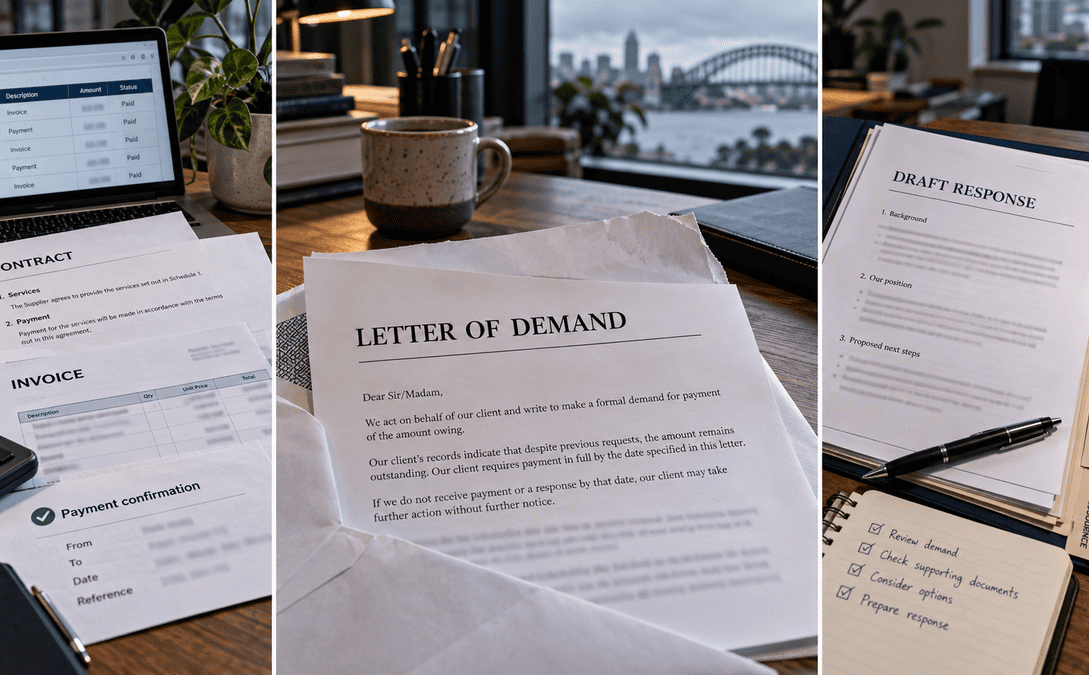
A letter of demand in Australia is usually a formal written request asking someone to pay a claimed debt or meet another obligation. It often identifies the parties, explains why the sender says money is owed, specifies an amount, gives a date for responding and warns that further action may follow.
It can arise from an unpaid invoice, private loan, disputed service, commercial agreement or another civil dispute. The sender may be an individual, a business, a solicitor or a debt collector. A solicitor’s letterhead does not turn an allegation into a finding of fact.

For unpaid debts, Legal Aid NSW explains that a recipient can admit a claim, deny it, ask for further information or negotiate. The best option depends on whether the underlying debt is valid and whether the sum and dates can be substantiated.
What happens after a letter of demand arrives?
Usually, nothing happens automatically on receipt. The sender waits for payment, a reply or the date stated in the letter. The parties may then exchange documents, negotiate, resolve the issue through mediation or consider formal proceedings. The precise path is not identical in every state or territory.
Verify the sender, amount, reason, requested action and stated response date.
Agree, dispute, request particulars or suggest a realistic resolution.
The matter may settle, continue through negotiation or proceed to a relevant court or tribunal.
Does the deadline in the letter have legal force?
A date printed on an ordinary demand letter is not automatically a court-imposed deadline. It signals when the sender intends to reconsider their next step, though certain contracts, laws or pre-action procedures may impose additional requirements. Do not assume that any date can safely be ignored.
What if you have already been served with court papers?
That is a different situation. For example, NSW Local Court defendants generally have 28 days after service of a statement of claim to respond, and failing to do so may allow an application for default judgment. That NSW rule should not be treated as a universal response period across Australia. If court documents have been served, follow the applicable court’s directions and seek advice promptly.
Documents and evidence to prepare before replying
Good records help you work out whether the claim has a basis. Read the letter alongside the documents that created the obligation, rather than evaluating it in isolation. If a business claims an invoice was never paid, for instance, payment records may show the invoice was paid, partially paid or issued for work that was disputed.
Your response file: what to gather
- Contracts, terms, purchase orders or quotes
- Invoices, receipts and bank payment records
- Relevant emails, messages and letters
- Delivery records or evidence of work completed
- Dates and notes of phone conversations
- The original demand and proof of when received
Compare names and legal entities carefully: a trading name, a company and its director are not automatically interchangeable. Check calculations, dates, interest and added collection costs. Victoria Legal Aid notes that extra recovery charges may not be payable simply because they appear in a demand; relevant terms and laws matter.
Preserve originals and store a dated copy of your reply. Where the demand is unclear, request itemised particulars and supporting documents without making an admission about the claim. Avoid sending confidential or irrelevant personal information merely because the sender asks for it.
Choosing how to respond
| Your position | Possible next step |
|---|---|
| The claim is correct | Discuss payment, request confirmation of the balance and obtain a written record of any arrangement. |
| Part is correct | Explain which components you dispute, with the supporting figures or documents. |
| You dispute it | Set out the main factual basis of your disagreement and ask for a clear reply. |
| You cannot verify it | Ask for the underlying contract, invoices or calculations before taking a substantive position. |
Keep a written record of any settlement proposal. If you are unsure whether a payment, acknowledgement or settlement wording could affect your rights — especially with an old debt — get legal advice first. Limitation periods vary by claim and jurisdiction, and payments or written acknowledgements can sometimes matter.
Common misunderstandings and potential consequences
“If a lawyer sent it, the amount must be correct.”
Not necessarily. A lawyer can present a client’s position, but the underlying evidence still needs to support it. Check the amount and legal basis rather than relying on the sender’s title.
“Nothing happens if I ignore it.”
Sometimes the sender does not pursue a claim. In other cases, silence may be followed by negotiations, debt collection or litigation, potentially adding costs. The risk is not that an ordinary demand automatically enforces itself, but that the dispute can escalate.
“They can immediately seize my belongings.”
An ordinary demand letter does not authorise a sender to seize assets. Enforcement generally requires a legally available process, and secured debts or other special regimes have different rules. Misleading threats and undue harassment in debt collection are prohibited: the ACCC explains collectors’ legal obligations.
“A statutory demand is just another strong letter.”
For companies, it can be significantly more serious. A creditor’s statutory demand under the Corporations Act 2001 uses a prescribed process and generally carries a strict 21-day period for compliance or for an application to set it aside. The Federal Court’s guidance explains this procedure. A company receiving one should seek urgent specialist advice, rather than follow the approach for an ordinary letter.
The useful question is not only “How quickly must I pay?” but “What document is this, what supports the claim, and what are my lawful options?”
Practical decision principle
Consumer credit disputes may also involve statutory default notices, hardship arrangements and external dispute resolution. Those options are not identical to a dispute over a private invoice. For disputed debts, the ACCC’s debt-dispute guidance explains possible complaint and dispute resolution pathways.
When should you obtain legal advice?
Legal advice is particularly valuable if the facts or amounts are disputed, the letter cites unfamiliar legislation, the claim is old, the proposed settlement has ongoing consequences, or you are unsure whether the document comes from a court or is a statutory demand. The larger the financial or commercial exposure, the more important it is to get advice before making admissions or signing a settlement.
If you cannot afford the requested payment, it may also be worth speaking with a financial counsellor about your options. The National Debt Helpline provides free financial counselling information for people dealing with debt.
A practical first response
Confirm receipt, state whether you agree or disagree with the claim, and request missing documents if necessary. Keep the tone calm and factual, and preserve copies of the correspondence. Do not promise to pay an amount you have not checked or issue legal threats of your own.
Questions people often ask
Can I ignore a letter because it came by email?
No. A demand can be communicated by email. Check whether the sender and attachment are genuine, then assess its contents. Different legal documents have different formal service rules, so do not assume all emailed notices are equivalent.
Must I pay every fee and interest charge in the letter?
No, not automatically. The entitlement to extra amounts depends on the contract, the applicable law and the particular claim. Ask how each charge was calculated and seek advice where it is disputed.
Will replying mean I admit the debt?
Not necessarily. You can request details or dispute a claim without making an admission, but careless wording can have legal consequences. With an old or complex debt, obtain advice before acknowledging liability.
What if the sender starts court proceedings?
Read the court documents immediately. Court forms and response deadlines are different from an ordinary demand letter, and failing to respond may permit a default judgment. Check the relevant court’s requirements for your state or territory.
The sensible next step is to read the document carefully, preserve the evidence and make a deliberate response. Prompt, accurate communication may resolve the dispute before litigation — and if it does not, your records will be valuable.