If you’ve ever wondered whether growth hacking is just a fancy buzzword marketers throw around at networking events (right before bragging about their TikTok followers), you’re not alone.
The truth is, growth hacking and traditional marketing are two very different approaches. One is like bringing a Swiss Army knife to a business problem, while the other is like bringing an entire tool shed. Both have their merits, but which one works best in 2025 for Australian businesses?
This article breaks it down in plain English (with a dash of humor and a few quizzes to keep things fun). By the end, you’ll know exactly how growth hacking differs from traditional marketing—and when to use each.
Snapshot Summary (Quick Overview)
- Growth hacking is lean, experimental, and focused on rapid growth with minimal cost.
- Traditional marketing is structured, brand-driven, and often budget-heavy.
- Growth hacking thrives in startups and SMEs where agility matters most.
- Traditional marketing dominates in corporate campaigns that need scale and brand consistency.
- The smartest marketers in 2025? They’re combining both.
Curious to see which fits your business better? Keep reading!
What is Growth Hacking?
Growth hacking is like the MacGyver of marketing: minimal budget, creative experiments, and lots of duct tape.
Coined in 2010, it refers to low-cost, high-impact marketing strategies designed to quickly grow a business, often using digital tools.
Examples in Australia:
- A Melbourne café offering free coffee if you post a TikTok about them.
- A Brisbane fintech startup using referral programs to get thousands of new users in weeks.
- A Perth e-commerce store leveraging “buy now, pay later” promos with influencers instead of traditional ads.
Did You Know?
Canva, Australia’s famous design unicorn, used growth hacking in its early days by making design templates easy to share—essentially turning every user into a brand ambassador.
What is Traditional Marketing?
Traditional marketing is the seasoned professional of the room—steady, reliable, and expensive.
It includes:
- Print ads (newspapers, magazines).
- TV and radio campaigns.
- Outdoor billboards and flyers.
- Sponsorships and event marketing.
In Australia, think: footy sponsorships, newspaper real estate sections, or those massive highway billboards you pass on the way to Geelong.
The advantage? Massive reach and brand authority. The downside? High cost and slower feedback loops.
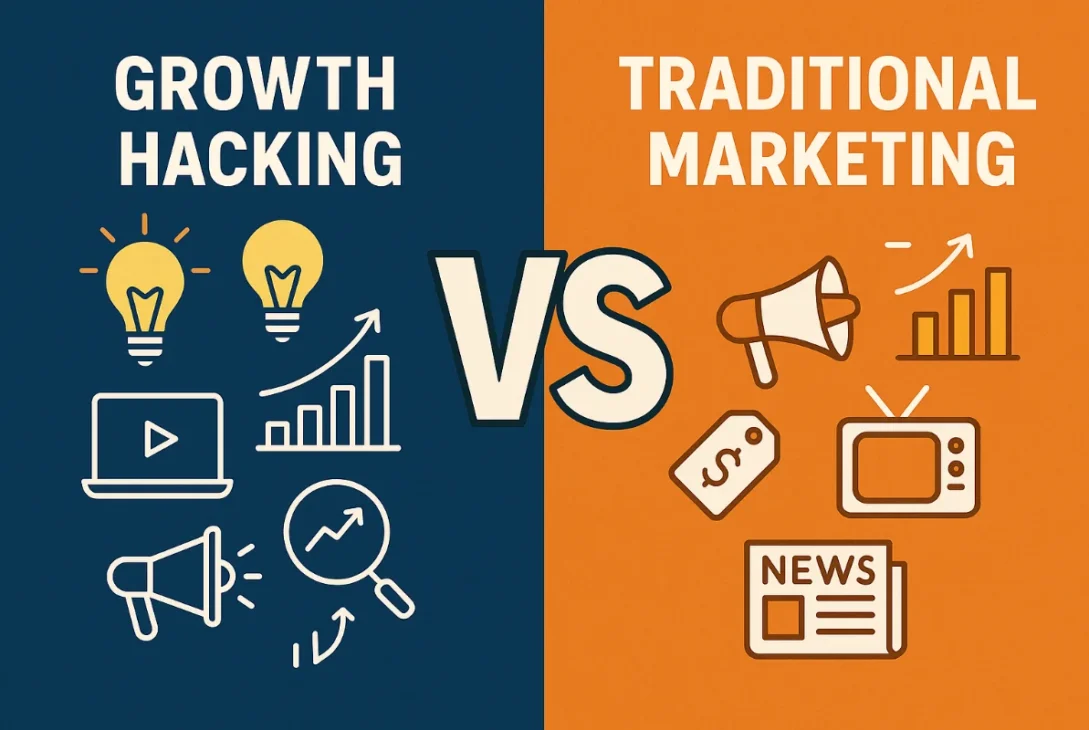
Key Differences: Growth Hacking vs Traditional Marketing
| Feature | Growth Hacking | Traditional Marketing |
|---|---|---|
| Speed | Fast experiments | Longer campaigns |
| Budget | Low, scrappy | High, structured |
| Focus | User acquisition & growth | Brand awareness & positioning |
| Tools | Digital-first (SEO, social, email, analytics) | Print, TV, outdoor, events |
| Best for | Startups, SMEs, online businesses | Corporates, established brands |
Quick Guide: Choosing Between Growth Hacking & Traditional Marketing
Picture this: You’re launching a new online service in Sydney. Do you pour $100k into TV ads, or try 50 small experiments with $2k each?
Common Challenges
- Do you need rapid results on a small budget?
- Do you value experimentation over predictability?
- Are you chasing growth or building long-term brand equity?
How to Solve It
✔ Test and Measure
Start with small, low-cost growth hacks to validate what works.
✔ Layer Traditional Marketing Later
Once you know what sticks, invest in bigger campaigns for reach and credibility.
✔ Mix Both Approaches
Even a scrappy startup can benefit from a small print ad in a local paper if the audience is right.
Why It Works
This hybrid approach balances speed and scale, giving you both rapid acquisition and brand longevity.
Pro Tip: In Australia, local events (traditional) + social sharing incentives (growth hacking) = one powerful combo.
Interactive Quiz: Which Marketing Style Fits You?
Q1: Your business budget for marketing is under $10k. Do you…
- A. Try small digital experiments (growth hacking).
- B. Buy a half-page ad in the local paper (traditional).
Q2: You want 1,000 customers in 3 months. Do you…
- A. Launch referral and viral campaigns.
- B. Book a long-term radio slot.
Q3: You love data and testing. Do you…
- A. Run weekly A/B tests.
- B. Trust brand awareness will eventually pay off.
(If you answered mostly A’s: You’re a growth hacker at heart. Mostly B’s: You’re a traditionalist. A mix? You’re hybrid—and that’s often the smartest path.)
The Australian Context: Why Growth Hacking is Rising in 2025
- Startup boom: From Sydney fintech to Melbourne healthtech, Australian startups are scaling fast.
- Digital adoption: 94% of Australians are internet users, making digital-first strategies vital.
- Cost of living pressures: Businesses need cost-efficient marketing strategies more than ever.
- TikTok & Instagram dominance: Younger audiences spend more time here than on TV or print.
That said, traditional marketing still holds power in property, finance, and law—industries where trust and reputation outweigh quick hacks.
FAQs About Growth Hacking vs Traditional Marketing
1. Can small businesses in Australia really rely only on growth hacking?
Yes—but it works best for digital-first businesses. If you’re running a local plumbing service, mixing growth hacks (Google reviews, referral discounts) with traditional (flyers, local radio) is often smarter.
2. Is growth hacking legal and ethical?
Mostly yes. Just don’t cross into spammy territory. Growth hacking is about creativity, not cutting corners.
3. Which is more expensive?
Traditional marketing almost always costs more (TV ads, print, events). Growth hacking is designed to stretch budgets.
4. Which lasts longer—growth hacks or traditional campaigns?
Traditional builds long-term brand equity. Growth hacks often give short-term spikes, but can be stacked for ongoing results.
5. Should I hire a growth hacker or a traditional marketer?
Hire based on goals. If you want fast user acquisition on a budget → growth hacker. If you want brand presence and trust → traditional marketer.
Lighthearted Section: The Fun Side of Growth Hacking
Some famous (and quirky) growth hacks:
- Hotmail added “Get your free email at Hotmail” to every outgoing email in the 90s—viral gold.
- Dropbox gave extra storage for every friend you referred—legendary.
- An Aussie café once offered “pay with a joke” discounts—it went viral on Instagram.
Moral of the story? Growth hacking is often about being bold, creative, and a little cheeky.
Conclusion
In 2025, Australian businesses don’t need to choose just one. Growth hacking gives speed, agility, and cost savings, while traditional marketing provides reach, authority, and long-term stability.
The smartest strategy? Use growth hacking to test, learn, and grow quickly—then back it up with traditional campaigns once you’re ready to scale. That way, you’re not choosing between being clever or credible—you’re being both.
Disclaimer
This article is intended for general informational purposes only. It is not marketing, legal, or financial advice. Always consider your specific circumstances and consult a professional before making strategic business decisions.